I’m really excited by this tender opportunity, and I love that the senior leadership within the church have a clear desire and ambition for it to remain focused on community use. So for me it’s about creating the best community space, whilst ensuring it is commercially viable to support the significant long term maintenance costs of a listed building.
On my recent visit to Honiton I could not believe just how great the location is, it’s incredible.

As you’ll see from my history of projects I’ve opened 25+ coworking / makerspaces in the past, so I know what is possible and what is viable.
I’d love to create a space that leaves the original building in exactly the same format, and carefully design wooden sustainable structures thereby only adding modular spaces within the envelope of the building, that could later be removed without any impact on the building whatsoever.


My gut feeling is that in order for it to be successful it needs to have a range of uses, this gives it a number of revenue streams, so I’ve put together a range of aspects below that I believe will give the project the best chance of being successful:
- I believe we can create a community space that gives people the opportunity to start their own small businesses and projects (genuinely affordable space for around 50 local individuals… around the £35 – up to £100 pcm for unlimited access to hot desking the work space, and a bit higher for a fixed desk space within the private pods / modular offices).
- It can also be an open studio / art gallery, as the walkway around the pods will give space to display art (so there will be set days that it’s open to the wider public for free).
- At set hours each week (predominantly evenings / weekends) it can be used for noisy craft and carpentry projects within the workspace area (see bottom right corner on visual above). A carpentry space within a church seems like a very humbling pitch.
- It can have a wide selection of kit for people to use, a pottery wheel, 3D printer, laser cutter, large format printer etc (also as a: Tool library), one of the modular pods could be a darkroom for traditional photo development?
- I believe it would also form a really exciting part of my own not-for-profit organisation Nomadhut, I didn’t think we’d ever look at opening in the UK, but this makes it a maybe just maybe. We could have a few pods for remote workers to come and stay (I’ve modelled 3 in the visuals, these would contain a double bed, and a private workspace, although they will mostly work in the shared space). This aspect would really be the element of the financial model that helps supplement / fund the ongoing maintenance of the space and subsidise the coworking member costs ensuring it remains affordable for locals.
- Having a flexible use of the space ensures that it is used throughout the year, and at all hours of the week. Hopefully this plays a significant part in helping to reduce instances of vandalism.


Mini pods
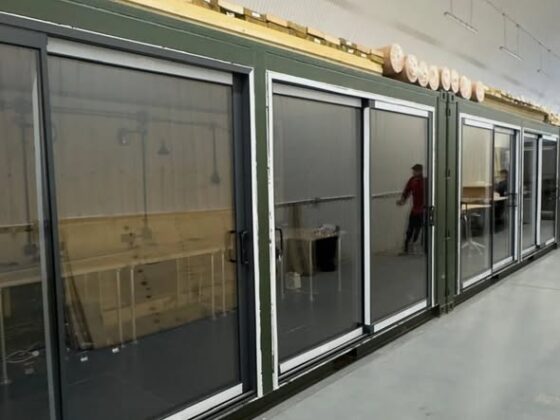
These mini pods I am trying to describe will ensure flexible use of the space, allow multiple uses, ensure that the heating costs are manageable (as it’s impossible to heat such a large old building in the winter), and will also mean that there is no impact on the fabric of the building (I think East Devon conservation officers and Historic England heritage etc will hopefully like this proposal for that reason). I have pasted a few pods that we could use to help guide us, and I will enjoy designing/picking the most relevant style in partnership with the community and stakeholders (Church, Council, Historic England etc).


I’ve mocked up a quick visual to help understand how the pods could look within the space, although small they could be big enough for 2 (we could even build a slightly larger version for 4 people, but I wouldn’t want to go too big to ensure it’s more of an incubator to help start businesses/projects and not be reliant on one member for a significant portion of the revenue to sustain the building, multiple revenue streams ensures long term sustainability). The other aspect which works in favour of this pod style solution is that we can balance out the internal slope of the building.

Additional Background
While we’re busy getting Nomadhut Tenerife off the ground (getting the electric on, windows in, walls plastered, floors fixed, bureaucracy battled), I’ve had a bit of time to think about… what comes next.
Now, choosing our next location isn’t as simple as spinning a globe and pointing blindly — though I’ve definitely considered it. The truth is, if we pick the right place, we’ll have the momentum to keep growing the Nomadhut network. But if I mess it up? Well… let’s just say that’ll slow down our progress to provide affordable space for the creative and entrepreneurial souls we love.
Right now, most of the decision-making is powered by gut instinct and whatever scraps of booking data I can spy on from other coliving spaces (public calendars, I’m looking at you). I’m building a separate website that should, eventually, give us proper search data and metrics to guide these decisions — but in the meantime, I’m getting my boots on the ground and visiting possible sites in Italy, Portugal, and mainland Spain. Research, but make it road trip (whilst equally still undertaking the role of running the Bermondsey Business Improvement District… I wear many hats).
Now here’s the twist: I never seriously thought we’d open a Nomadhut in the UK. Why? Because property prices are bananas, and our goal is to keep membership genuinely affordable. (No one wants a “coworking / coliving” space that feels like a WeWork in disguise, charging £1K a month for a glorified bunk bed). I want there to be private rooms with access to workspaces etc all for under 500 a month in every country we open… and fixed desks / hot desking for under 100 per month, that’s cheaper than most things I’ve seen anywhere, that’s the challenge, it’s doable… but the only way that is remotely possible is finding buildings that affordable to buy. They can’t be absolute projects, but luckily having bought 25+ commercial buildings back into use I have a good handle on what is possible, and what to run from!
But… then I saw these 2 buildings. There are currently TWO properties in the UK we’re submitting offers on (This one in Devon, and one in Scotland). We can only afford one — and even that’s going to be tight.
One is a listed building — which sounds charming until you realise what that entails, and the difficulties and challenges that brings. I’ve previously worked on 8 listed buildings and therefore I can come at this with a partial understanding the challenge, I’m not going in blind.
So yeah, slightly mad, potentially magical. That perfect meeting point.

The building in Devon is owned by the Church… although land registry doesn’t have any ownership data on the building.
My plan would be maintain the building in it’s current format, without making any changes (with the exception of adding additional toilets in the same location as the current ones, given how they’ve been put in I’m sure we can do something a little better).

As I’ve touched on previously the only addition I would be making is adding prefabricated pods that would be designed in partnership with the Council and English Heritage. This ensures we preserve the building in its current format for future generations, and it gives us the opportunity to access the areas that need work to maintain the structural integrity of the building, without impacting on day to day workings.

I think this plan really opens up the space to the local community, whilst having a commercial basis to underpin it’s viability and the long term security of maintaining the building for future generations.

A respectful and reversible transformation of the Grade II* listed Former Church into a creative hub, centred on:
- Artist studios
- Flexible coworking and event space
- 3 modular live/work pods for remote workers who have the ability to travel (Think glamping huts), all freestanding and non-invasive
This model protects and showcases the building’s historic integrity while injecting it with new, low-impact life — aimed at artists, creatives, and social entrepreneurs.
Design & Heritage Approach
- No permanent fixtures — all units would be modular pods, designed to sit independently within the existing volume and moveable with the space. Designed in a way we could use pallet trolleys to move them into different positions within the space.
- Reversibility guaranteed: All interventions can be removed, ensuring no permanent impact
- Lighting and acoustics sensitively adapted to protect features and enhance the space for exhibitions, quiet work, and community events
- Use of timber, glass, and textile finishes inside pods to create a warm contrast to the existing stone and stained glass
Community Benefit
Strong engagement with the town’s creative and social fabric
A community-accessible events space for talks, exhibitions, workshops
Opportunities for local residents to access workspace
Educational partnerships with schools, colleges, or local arts groups


https://www.geograph.org.uk/reuse.php?id=5740951 Photo by Lewis Clark.
A large communal Kitchen
8 Pods for startups and creative organisations:
The pods would be private offices for 1-2 people, thereby supporting micro businesses / startups (we could have a few which were 2 – 4 people, depending on demand). We would be extremely affordable. I’ve drawn 3 of them without the walls etc, to highlight how they could be offices, art studios or craft/maker spaces.
Hot desking or fixed desk space…
3 Remote live / work pods (imagine it like a better version of glamping, within a church, with access to high speed internet and fully kitted out kitchens and workspaces / makerspace… for creative retreats).
Space for Artist residencies, Writers, Entrepreneurs and Creatives to come and work for a month(s).
A workshop / craft area & tool library
We would be able to reconfigure the space for community events and performances
All whilst maintaining the building in the design and format it was originally setup in.
The building is near to the local train station, 2hr 50mins on a direct route from London Waterloo, or London Paddington to Exeter, and then a short hop on a train Honiton (25 mins).
So I think it could generate c£30 – 50k per annum once fully operational, it’s not huge sums, but at least it provides sum viability for undertaking the repairs needed to maintain the building.
Challenges / unknowns / questions:
1. The staircase route to the tower was not viewable when I visited the church with the agents, they said an architect had ruled it unsafe. Did we manage to get an update from the architect? did they just not want those viewing to be at risk for health and safety reasons or is there structural issue?
2. The slope of the floor internally was clearly evident, I would like the opportunity to chat with those who have been visiting / using the church for a number of decades. I would also obviously need to undertake a full structural survey. Given that it’s a grade II listed building I’m pretty certain the church and/or English Heritage must have undertaken such surveys recently? (especially given the angle of the slope). Internally and externally there weren’t signs to make me feel concerned enough to rule this building out of my search.
3. The other listed structure is the Lych gate / entrance way to the church yard. I had a really good chat with Karen and David in the old house by the entrance to the chruch yard. Accordingly the gates are being stored within the church, whereas the English Heritage website says that the whereabouts are unknown(???).
4. I think any prospective use case for the space might face challenges in the winter months given the volume of the space and I’m presuming very poor EPC.
5. In order for this type of project to succeed it needs lots of stakeholders to believe in the project and be supportive as listed buildings can be hugely challenging… so I will be seeking and appreciate candid feedback from local councillors, conservation officers, English heritage, the church and East Devon council etc
6. The building currently has single phase electric, in order for the building to work I’d need to get mains gas installed or upgrade to 3 phase power (as each pod would require a heater, they are usually c1Kw+ so we’d struggle with just single phase.
Financial Projections
(Lots of assumptions, as most business owners and entrepreneurs are aware this type of modelling is very ball park… however what did come out of the exercise is the uplift moving from 3 to 4 coliving/working pods made a huge impact to the financial projections). Also year 1 is actually year 2 in reality, as we’ll lose at least a year in planning / fitout… (I haven’t done 5-10 year projections, happy to talk through why if needed). Also I haven’t built into the numbers the c£150k fitout costs, so when you look at the projected profit numbers please give them some context).
3-Year Financial Projection for Nomadhut Devon, based on:
- 4 coliving pods + 7 private office pods (14 seats), + hot desking
- 90% occupancy across all areas (This will obviously flex across the different aspects).
- Ownership / Low rent scenario (£10k/year)
- Modest annual growth:
- +5% revenue/year
- +3% expense inflation/year
3-Year Projection Summary
| Year | Revenue (£) | Expenses (£) | EBITDA (Profit) (£) |
|---|---|---|---|
| Year 1 | £116,520 | £80,000 | £36,520 |
| Year 2 | £122,346 | £82,400 | £39,946 |
| Year 3 | £128,464 | £84,872 | £43,592 |
Revenue Breakdown (at 90% Occupancy)
| Revenue Stream | Amount (£) |
|---|---|
| Coliving (4 pods) | £49,887 |
| Private Offices (14 seats) | £27,972 |
| Hot Desk Memberships (37 @ £75 avg) | £29,970 |
| Additional Revenue (15%) | £8,691.30 |
Interpretation
Fairly good margins (~34–35%) without needing major scale (but this is needed when dealing with a grade ii listed building as something will come along unexpectedly)
EBITDA grows steadily from £36.5k to £43.6k over 3 years (as above I’d be in cloud cuckoo land if I really believed business plans, unexpected things always happen).
Total net gain over 3 years: £120,000+ in operating profit (this’ll read quite high, however I will have probably spent this amount on the fitout, so really this isn’t profit in the usual sense).
✅ Operating Expenses (£70,000/year + £10k rent) — What’s Included:
Core Services
- Utilities (electricity, water, business rates)
- Internet & IT infrastructure
- Insurance (public liability, contents, property)
Facilities & Operations
- Cleaning services
- Repairs & maintenance
- Supplies (toiletries, consumables, printer paper, etc.)
Staff & Admin
- Operational staff / caretaker (2 x part-time)
- Admin or remote support (bookings, memberships, invoices)
Marketing & Outreach
- Local advertising, social media, Google Ads, partnerships
Software & Subscriptions
CRM, booking platform, accounting tools, door access systems
Statement on Parking and Accessibility
(with the exception of turning the church into a private residence I can’t think of any use case that doesn’t face similar dilemmas to think through).
We acknowledge the concerns raised regarding limited parking in the area — an issue we ourselves flagged early in the process with the agents (happy for the agents to share that email). The fact that the church has now echoed similar concerns back reinforces the need to approach this site with care and a long-term, sustainable mindset.
That said, Nomadhut Devon is uniquely positioned just 400 metres from the train station, with direct rail access to both London and Exeter. The project has been designed around this asset, catering to users who don’t rely on private vehicles and instead value walkable, car-light lifestyles.
🚆 Car-Free by Design — With Smarter Shared Transport
Rather than contributing to car dependency, the proposed use supports:
- Remote workers, digital nomads, and tech founders who arrive by train and work on-site
- Short- to mid-term residents (1–12 weeks) who don’t bring vehicles
- Eco-conscious travellers and creatives who prefer cycling, walking, or public transport
In addition to minimising on-site demand for car use, we see an opportunity to enhance sustainable travel for the broader community:
We would actively explore the introduction of two Zipcars (or similar car club vehicles) within a short walk of the site.
This would allow visitors and locals alike to make occasional car journeys without needing to own a vehicle, which in turn strengthens the case for travelling by train — not just for Nomadhut guests, but for the neighbourhood as a whole.
✅ Use Cases With Minimal Parking Demand
The building lends itself naturally to uses that do not generate significant parking needs, including:
- Artist or writer residencies with defined timeframes and car-free travel expectations
- Startup retreats or founder sabbaticals where work is done on-site and car use is unnecessary
- Coaching intensives, workshops, or local events with attendees arriving by train
- Creative studio space for local residents arriving on foot or by bike
We remain committed to ensuring this space adds value to the community without placing additional strain on local infrastructure, and believe a car-light, train-first approach is not only feasible — but desirable in this location.