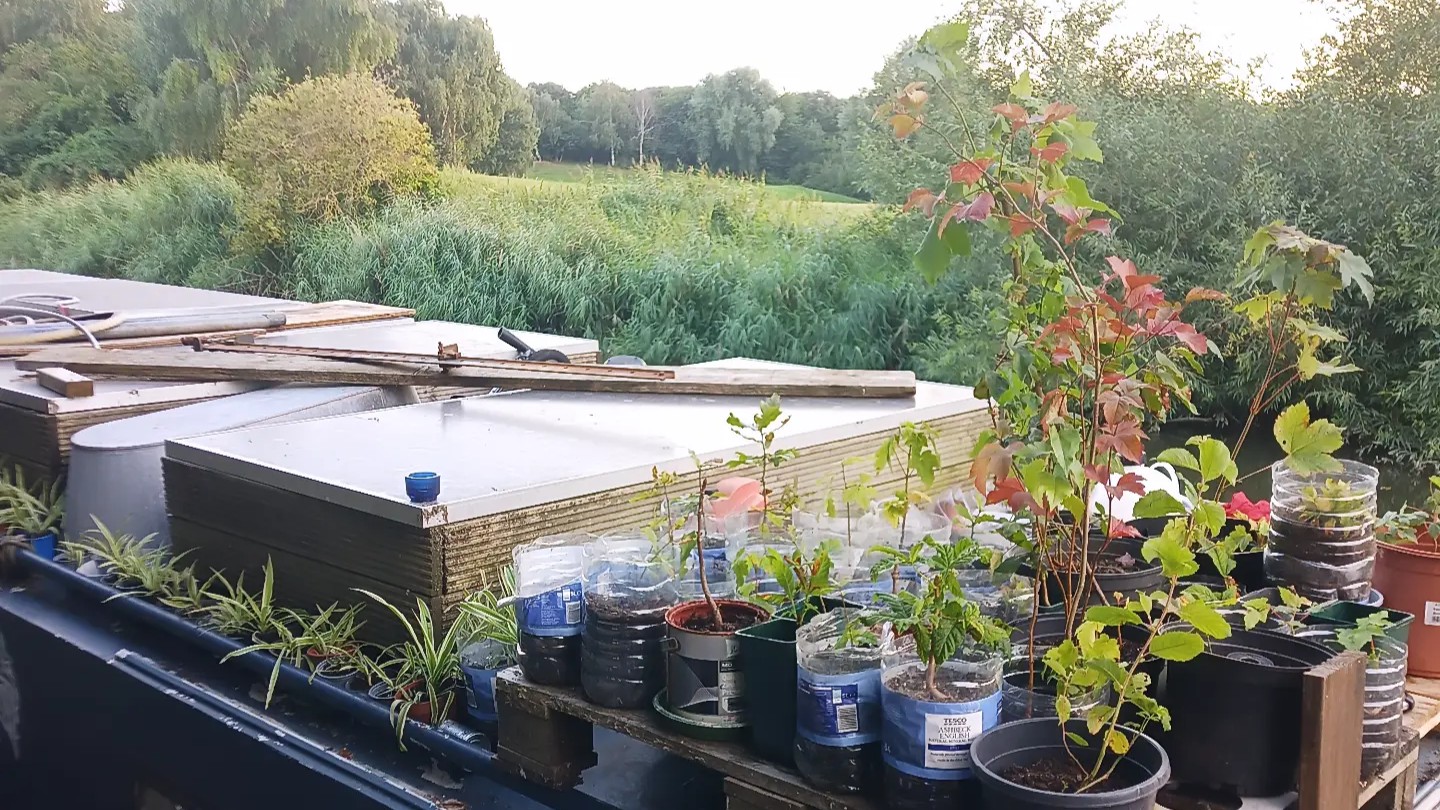
Many of you know that I tried growing and planting lots of trees myself.
The problem is that I live on a boat, and I have to move it every two weeks. Growing the trees was relatively easy. Helping nearly 50 tiny trees establish themselves after planting them was not.
And with the droughts we’ve had, I doubt many of them survived (there in lies another issue, I can’t visit and track their progress).
If I owned a farm or a chunk of land, this would be easy. But I’m not landed gentry, so I don’t have that luxury.
So what am I going to do instead… and, more importantly, why am I doing it?
The elephant in the room: air miles
I don’t want to hide this, and I don’t want to fluff it up with sustainability marketing.
I fly.
At the moment, while I’m trying to build Nomadhut, I fly a lot. I’m doing most of the construction myself because I simply don’t have the money to pay other people to do it, so there is currently a fairly chunky carbon deficit attached to what I’m doing.
I know the problem. I’ve researched the problem. And I’ve been thinking a lot about what I can realistically do about it.
Is my solution perfect? No.
But I am on a mission to make sure that, over time, the environmental impact of my entire life, including the bit before I made this decision, is accounted for.
That’s a big statement, but I think it’s doable.
And I want Nomadhut to go further than just looking at the building itself.
Eventually I want us to think about the journeys our guests make to reach us too. When someone books, we’ll ask where they’re travelling from and estimate the carbon associated with that journey. Nomadhut will then fund additional environmental projects against it.
I’d love guests to go further themselves, but I don’t think we should simply say, “That’s your flight, therefore that’s your problem.”
If we’re encouraging people to come and stay with us, I think we have some responsibility for that too.
The easy stuff isn’t enough
Renewable energy, recycling, reducing waste, reusing materials, buying second-hand and limiting the amount of new material used during our fit-outs are all part of the plan.
But those are further down this page for a reason.
Lots of businesses talk about working towards Net Zero, being B Corp, using recycled materials, making products from old bottle tops, and so on.
None of those things are bad.
But I think we’ve become very good at turning sustainability into marketing.
Having run coworking spaces, I’ve also seen how easy some accreditations and sustainability claims can be to achieve. For me, much of this stuff should be the starting point, not the achievement.
So I want to concentrate on things that have a measurable impact.
And I want to publish what we’re actually doing rather than just tell people that we’re “sustainable”.
I’ve done a lot of research on this already, and I’ll continue doing it as the science, technology and evidence develops.
So what are we actually going to do?
1. Plant trees. Lots of them.
We’re going to fund tree planting and ecological restoration, and then keep doing it.
When you book with Nomadhut, we’ll ask where you’re travelling from and use that to estimate the emissions associated with your journey.
We’ll then fund tree planting and other carbon-removal projects in response.
I’m deliberately not pretending that planting a few trees instantly makes a flight disappear. It doesn’t.
Trees take time to grow. Some die. Projects need to be maintained. Carbon accounting is complicated.
But planting and protecting forests has value far beyond carbon alone: biodiversity, soil, water, shade, habitat and healthier ecosystems.
And doing something measurable is considerably better than putting a green leaf on the website and calling ourselves sustainable.
2. Invest in technology that removes CO₂
This isn’t my first choice.
I’d rather protect forests, restore ecosystems and avoid producing carbon in the first place.
But I also think we’re going to need technological solutions.
There are around eight billion of us on the planet today, and the global population is expected to grow further before eventually levelling off.
If we’re struggling with emissions now, it’s difficult to imagine solving the problem purely by asking billions of people to consume less.
So as Nomadhut grows, I want part of our environmental budget to support technologies that genuinely remove CO₂ from the atmosphere and store it for the long term.
Some of those technologies will fail.
Some will probably turn out to be uneconomic.
But some may become incredibly important.
I think they’re worth supporting alongside ecological solutions rather than instead of them.
3. Keep doing what I’ve already started
Having realised that growing saplings on top of the boat I live on, planting them and then sailing away wasn’t a particularly effective reforestation strategy, I started paying other people to do it properly.
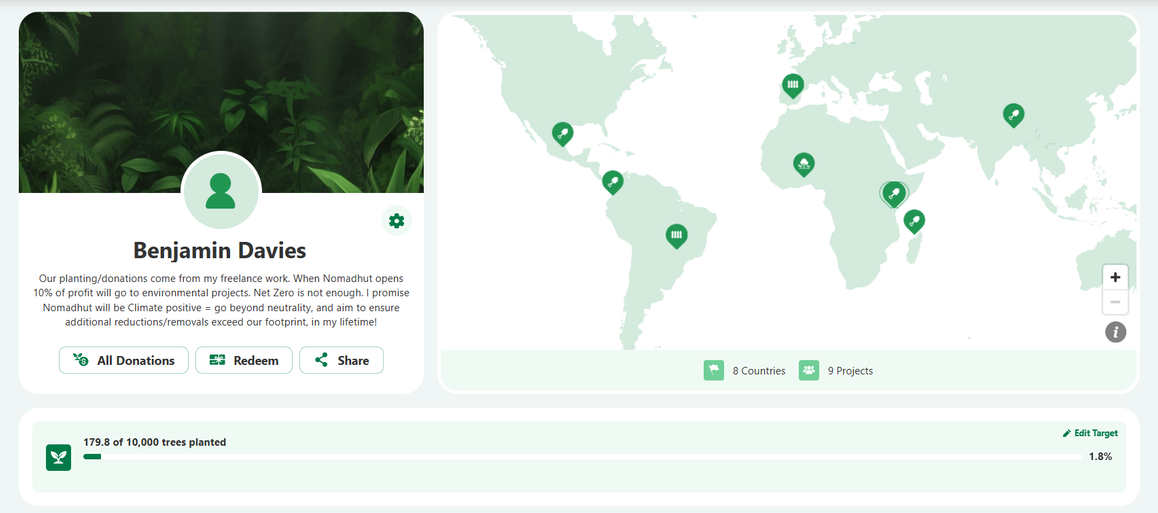
This screenshot from 2 October 2026 shows the number of trees funded so far, it’s taken a while to get to this point.
I’ve mainly been using Plant-for-the-Planet to contribute to planting projects around the world, although I’m very open to supporting other credible projects and platforms as I learn more.
At the moment I’m bootstrapping Nomadhut, so the amount I can spend is limited.
Once Nomadhut opens and starts generating revenue, that changes.
We’ll be able to support more projects, fund more planting and restoration, experiment with carbon-removal technologies and, importantly, publish what we’re spending and what it’s achieving.
I’m under no illusion that Nomadhut is going to solve climate change.
But I also don’t think “we’re only a small company” is an excuse for doing nothing, hence I started 2 years ago and I haven’t stopped.
So we’ve started small, yes obviously.
We’ll measure it.
Publish it.
Learn.
And keep increasing what we do as Nomadhut grows.
I don’t think normal corporate waffle “Net Zero by 2030 / 40 / 50” etc is enough.
That’s not because Net Zero is bad. It’s an important milestone.
But fundamentally, Net Zero means reaching the point where, on balance, you’re no longer adding more greenhouse gases to the atmosphere.
That’s a starting line for me, not the finish line.
It doesn’t automatically deal with everything you emitted getting there. It doesn’t undo the carbon associated with the buildings you’ve constructed, the products you’ve bought, the flights you’ve taken or the energy you’ve consumed over the previous 10, 20 or 30 years.
And depending on how it’s calculated, a company’s headline footprint may not even include much of the carbon generated throughout its wider supply chain and customer activity.
So my ambition for Nomadhut is different.
First, reduce what we produce as far as we realistically can.
Then account for what we can’t currently eliminate.
Then go beyond that.
And ultimately, I want to try to deal with the carbon associated with what came before we reached that point too.
In other words, I don’t just want Nomadhut eventually to stop making the problem worse.
I want it to make a measurable contribution towards making the problem smaller.